Working paper
Abstract
This paper studies air pollution IV estimates when instruments move several pollutants simultaneously and provides diagnostic tools for interpreting them. We distinguish two interpretations: a stimulus effect of the named pollutant holding co-pollutants fixed, and a proxy effect of the pollution bundle indexed by that pollutant. An empirical evaluation shows that adding controls, swapping the focal pollutant, or jointly instrumenting multiple pollutants can still leave nontrivial bias. We derive conditions under which single- and multi-pollutant IV estimates support either interpretation and provide a framework for quantifying bias when they do not. A crime application illustrates the framework.

American Economic Journal: Applied Economics
Abstract
We study the effects of a technical intervention in Karachi, Pakistan – converting bare distribution wires to aerial bundled cables (ABCs) – that was intended to prevent illegal grid connections and improve utility cost recovery. Theft-resistant cables reduced losses. This occurred primarily through decreases in unbilled consumption, with the number of formal utility customers and their billed consumption both increasing. Load shedding outages decreased. In areas with these cables installed, consumers have more appliances and higher electricity-related expenditures. Revenue recovery rose, but consumers’ billing-related complaints also increased.

Working paper
Abstract
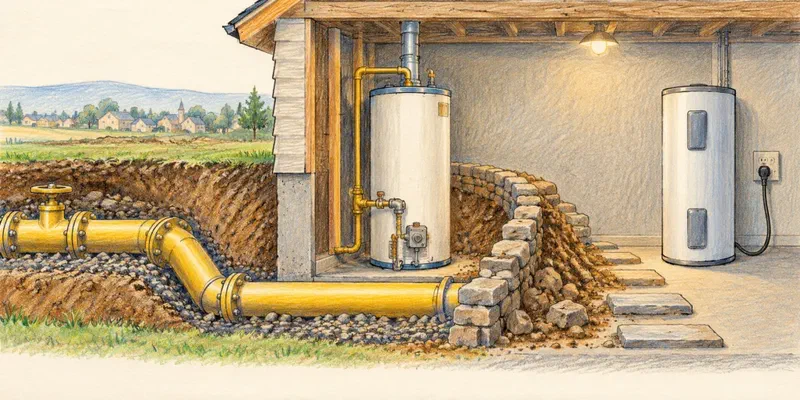
This paper investigates the potential cost of natural gas expansion when electrification is a long-term goal. I provide empirical evidence that natural gas expansion shifts consumer choice towards gas-powered appliances and increases the cost of achieving a high level of electrification. Leveraging the expansion of inter-city transmission pipelines in China as a quasi-experiment, I show that the increased accessibility of natural gas via infrastructure expansion significantly raises the market share and sales quantity of gas water heaters. To quantify the welfare implications for water heating electrification, I estimate a structural model of the water heater market, accounting for the impacts of gas infrastructure on consumer choice. Demand model estimates reveal that the expansion of gas infrastructure raises consumer valuation of gas water heaters relative to electric ones. This implies a higher cost of electrifying water heating when gas infrastructure is expanding, as the goal of electrification is to shift consumers towards electric appliances. Counterfactual simulations suggest that, with a 20% increase in gas infrastructure penetration, the cost of electrification rises from 1.4 to 2.2 billion USD, corresponding to an increase of over 50% relative to the status-quo gas infrastructure scenario. The increased cost of electrification will be weighed against both near-term environmental benefits and other consequences from natural gas expansion. The findings underscore a long-run economic burden of utilizing natural gas as a bridge fuel in the transition towards a net-zero carbon emissions future.
Decentralized Renewable Energy to Grow Manufacturing? Evidence from Microhydro Mini-Grids in Nepal
2025
Journal of Environmental Economics and Management
Abstract
Firms in developing countries often identify electricity as a major constraint to operations. Decentralized renewable energy sources, which are often promoted as a tool to achieve sustainable development, could help alleviate these constraints by providing “clean” electricity to locations that are difficult to reach with the centralized electric grid. We investigate whether electrification in Nepal – via microhydro plants and their mini-grids – helped grow the manufacturing sector and thereby induce structural transformation. Mini-grids led to a small but statistically significant increase in manufacturing establishments. Following electrification, females and males were more likely to be employees and less likely to be self-employed. Likewise, usual employment activities shifted from labor in agriculture to salary and wage work. In locations with smaller generation capacities, the impacts of mini-grids on labor-related outcomes were smaller. There is suggestive evidence of larger impacts in locations with better market access.

Utilities Policy
Abstract
Reliable electricity access is vital to economic growth, though financial challenges can undermine service quality. In Karachi, Pakistan, the local utility intervened to reduce losses and improve bill revenue recovery. The intervention increased budgets to improve infrastructure, provided staff incentives, and expanded customer engagement activities. We employ qualitative techniques to study managers’ and customers’ perceptions of the intervention and the mechanisms driving its effects. While managers credit the multi-pronged nature of the intervention for increasing trust and mitigating the effects of the COVID-19 pandemic, customers report no increase in trust and focus primarily on infrastructure improvements.

Journal of Environmental Economics and Management
Abstract
We study the effect of information provision on defensive expenditures, using China’s roll-out of air pollution information as a quasi-natural experiment. With a unique dataset of high-frequency mask purchase transactions, our difference-in-differences estimates show that the provision of air pollution information increases expenditures on PM$_{2.5}$ respirators by 32%, which is mainly driven by improved information quality and the addition of PM$_{2.5}$ index. The effect is enhanced by increased attention to pollution alerts and it is more pronounced during heavily polluted days. Our results shed light on the benefits of information provision through inducing defensive expenditures to reduce air pollution exposure.

Impacts of Electricity Quality Improvements: Experimental Evidence on Infrastructure Investments
2023
Journal of Environmental Economics and Management
Abstract
Hundreds of millions of households depend on electricity grid connections providing low quality and unreliable services. Understanding the impacts of and consumer response to electricity quality improvements is important for development and the environment. We investigate this in the Kyrgyz Republic through randomized improvements in the grid, which can improve electricity service quality. Treated households experience significantly fewer voltage fluctuations per day, an indicator of improved electricity quality post-intervention. Treated households’ billed consumption of electricity services increased during peak months post-intervention, with increases in consumption of 4% and 18% for homeowners and renters, respectively. Consistent with this, treated households, particularly renters, significantly increased ownership of electric heaters. Treated households invested more in energy efficiency, potentially mitigating their electricity bill increases post-intervention.

Journal of Regional Science
Abstract
Geographical distance constitutes friction of searching research collaborators. Taking advantage of a quasi‐natural experiment featured by High‐Speed Railway (HSR) lines in China, this paper employs the difference‐in‐differences model to identify the causal impact of a substantial improvement in the intercity transportation infrastructure on collaborative innovation across cities. The data pertain to a universe of patent applications filed by Chinese universities and their citations. We find that HSR contributes to a substantial increase in the innovation quantity and quality of collaborative patenting innovation between universities and corporates. It contributes to industry collaboration by utilizing university academic disciplines in the related technology fields. Lastly, HSR facilitates universities to search for new research partners with better quality beyond the geographical boundary.

Environmental and Resource Economics
Abstract
Under the Kyoto Protocol, the Clean Development Mechanism (CDM) expects to facilitate the North-South knowledge spillovers for climate-friendly technologies. This paper examines the effect of this voluntary international climate cooperation on firm innovation and knowledge spillovers through the lens of CDM projects in China. Using a matched Difference-in-Differences (DID) approach, we find that CDM projects contribute to firms’ innovation quantity, quality, and direction in renewable energy and energy efficiency technologies. These effects are more pronounced in inducing wind, hydro, and solar energy. We explore the role of foreign sponsors in knowledge spillovers. Sponsoring firms play the technology supplier role by raising the innovation quantity and quality, while sponsoring governments perform the information intermediary role by facilitating citation flows.

Journal of the Association of Environmental and Resource Economists
Abstract
Labor productivity, human capital formation, and income growth decline amid hot ambient temperatures. The implications of such temperature sensitivity for climate change damages depend upon the capacity for human adaptation to persistent temperature changes—as opposed to idiosyncratic temperature variation. Studying millions of collegiate track and field performances from 2005 to 2019, this paper shows that performance diminution in hot ambient conditions is mitigated by heat adaptation, a physiological response to heat stress and associated physical and cognitive impairments. Across varied specifications of the temperature-performance relationship, adaptation reduces performance losses from alternative climate change scenarios by more than 50%.